
Why Consistency Beats Intensity In Business: The Two Factory Story
Throughout my career leading companies, I have experimented with different approaches to drive sustainable, predictable growth. After many years of leading as well as leveraging my experience as a Certified Scaling Up coach, I have learned firsthand why sustainable business greatness favors consistency over intensity.
The Tale of Two Factories
Let’s use an example of two factories to compare and contrast consistency and intensity when it comes to scaling a business.
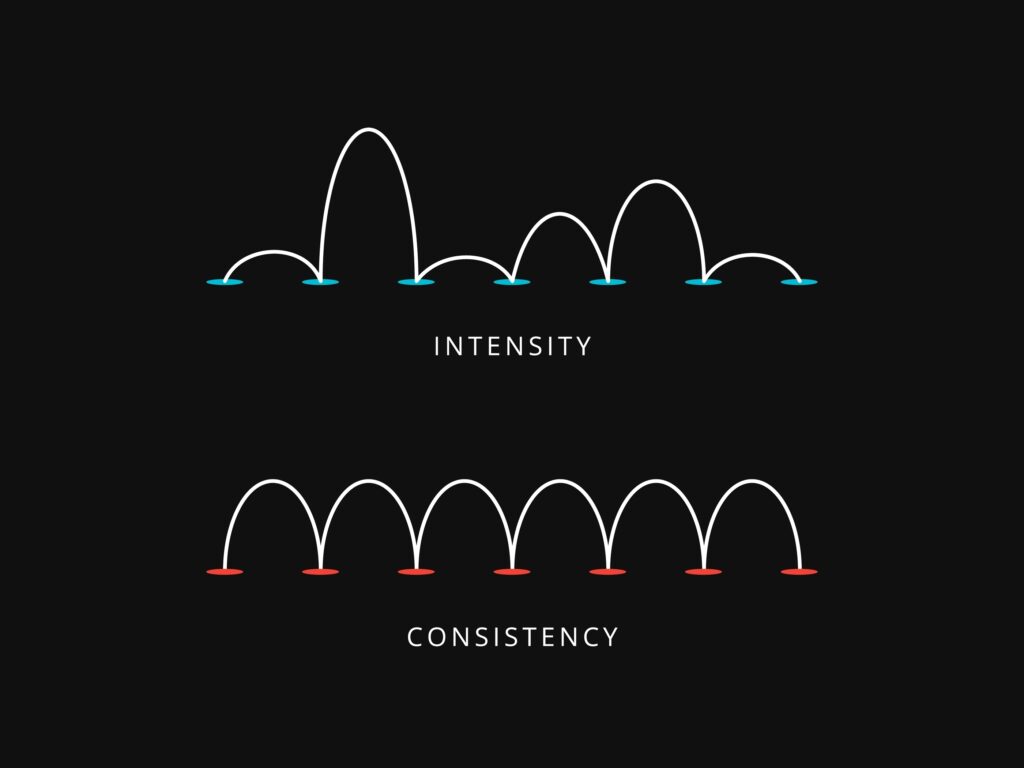
- Imagine Factory A, where the management team thrived on bursts of energy. Every quarter brought a new priority: one month it was customer service, the next was production speed, then another was new customer generation. There were moments of high excitement, like pizzas for the top performing teams, big kickoff meetings, even trophies.
- Across town, Factory B operated differently. Its leadership established daily rhythms: a 10-minute huddle every morning at all levels of the organization, a scoreboard in the break room showing weekly results, and a quarterly theme that was consistently reinforced. There were no grand launches or sudden shifts, just boring, reliable and repeatable behaviors.
So, it probably seems obvious that factory B would be more successful in the long run, and that is the correct answer. What made the difference for factory B wasn’t a single act of brilliance or a burst of intensity, but rather it was the compounding power of consistent effort and disciplined focus. However, go inside most executive teams and their companies, and you will see a tendency to lead like those in Company A. Why?
Why Intensity Is Tempting, But Tricky
Intensity often takes the lead in companies because it is seductive and delivers a rush. High engagement, attention, and sometimes a quick win can result from bursts of intensity. It’s what launches new products, rallies a team in a crisis, and powers through late-night operational roadblocks. But like a 100-yard dash, it cannot be sustained indefinitely. Afterwards, teams are left tired, priorities begin to blur, and without systems in place, progress stalls.
Even business icons like Jim Collins and Verne Harnish highlight this. Collins describes how companies achieve greatness through disciplined action and gradual momentum (the flywheel effect.) Harnish insists that scaling requires a steady rhythm including daily huddles, weekly checkpoints, and quarterly priorities. When leaders rely too much on intense starts, the follow-through fades, and chaos often creeps in.
Common Pitfalls of Leading with Consistency
Consistency sounds simple until leaders try to live it. It is damn hard to stay consistent despite best intentions. Stumbling blocks include:
- Chasing every new opportunity, confusing teams with too-frequent shifts in focus.
- Overcommitting, resulting in incomplete initiatives and staff burnout.
- Skipping routine accountability, which causes people to revert to old ways.
- Failing to install systems that reinforce the intended routine.
Any one of these can sabotage the discipline and patience real consistency demands.
How to Become That Consistent Leader
There are a handful of ways to become more consistent and ones that should be leveraged across your leadership team:
- Build rituals: Set daily and weekly meeting cadences. Yes, daily too, for all levels in the organization. These act as an operating rhythm and make accountability everyone’s habit.
- Prioritize relentlessly: Focus on one or two critical goals at a time, no more than that. By regularly reinforcing messages and efforts around these one or two critical goals, better results materialize and without confusion.
- Make data visible: Track key performance indicators, not just for leadership but for teams to see and own progress. Make sure these 2-3 performance indicators directly align to your top 1-2 goals.
- Model calm perseverance: Show up steady, both emotionally and operationally. People take cues from their leaders’ reliability, not just passion. Remember, team members are observing you all the time.
- Invest in process, not just people: Tools like SOPs, playbooks, and digital dashboards build a backbone for execution, even if key players change.
Where Intensity Fits
It is important to call out that I am not suggesting intensity has no value. There are moments for bold moves including big launches, sudden emergencies, and celebrations for big accomplishments. Used strategically, intensity accelerates. But it should remain the exception, a match to light the fire, not the fuel that keeps it burning.
The Business Leader’s Takeaway
The best organizations frankly aren’t those with the brightest bursts, but those that relentlessly execute the fundamentals, day after day. Boring? Kind of. Sustainable growth? Absolutely. That’s the real storyline behind legendary cultures, resilient growth, and teams that want to stay. Leaders who master the art of consistency through steady systems, patient focus, and repeated routines become the ones whose businesses compound trust and deliver results, year after year.
