
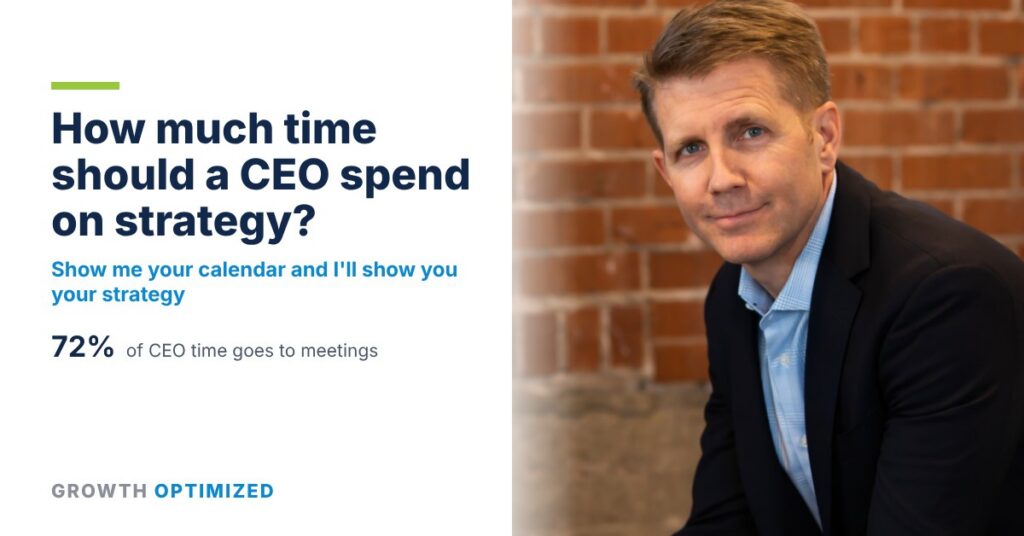
How Much Time Should A CEO Spend On Strategy Each Week?
By Bill Goodwin, MBA, Certified Scaling Up Coach and founder of Growth Optimized · Updated November 2026
At a minimum, a CEO needs two hours a week of uninterrupted strategic thinking time, away from the desk and the phone. That’s 5% of a 40-hour week, so it’s not much to ask. Ideally it’s four or six hours, but I’ll take two to start. The problem is most CEOs aren’t prioritizing those initial two hours per week.
How do I know? Show me your calendar and I’ll show you your strategy. For most CEOs I work with, the calendar reads anything but strategy.
In short:
- Most CEO calendars are 70% to 75% meetings, and most of those meetings are internal.
- Block at least two hours a week for strategic thinking, first thing in the morning, somewhere other than your desk.
- Pull yourself out of status meetings and get a one- or two-page summary instead.
- Start with a one-hour pilot, hold it for three or four weeks, then build to two hours.
What does a typical CEO’s calendar look like?
I can say this from my own calendar experience over the last 20 years: 70% to 75% of it was in some type of meeting. About half of those, if not 75%, are internal meetings like status updates, project reviews, one-on-ones and ad hoc meetings that pop up to solve some type of issue. The others were client calls along with the occasional board member call.
So in a 40-hour week, you might see 25 to 30 hours of committed meetings, with limited open space. And when CEOs do have open space, what are they doing? Email and returning calls, all stuff that’s reactive.
The research says the same thing. A Harvard Business School study by Michael Porter and Nitin Nohria tracked the time of 27 CEOs and found 72% of their work time went to meetings, while only 21% went to strategy. About a quarter of their time wasn’t scheduled in advance at all.
Why do CEOs of smaller companies struggle to make time for strategy?
When I tell a CEO to block time for strategy, they basically say, “Well, that’s not going to happen.” They’re involved in client calls, weekly meetings and huddles, and they just can’t figure out where they can create the time.
A Yale School of Management study of 301 CEOs, most running companies with $5 million to $25 million in revenue and 26 to 150 employees, shows what that costs. Those CEOs named mission, values and culture the most important part of their job, yet it ranked seventh out of eleven in where their time actually went.
How should a CEO use strategic thinking time?
Dedicated weekly time, with no distractions, and almost always in a different environment. I coach CEOs, and I do this myself, to go to a coffee shop or a separate conference room you don’t normally sit in. When you sit in the same spot every day, you get trapped in the same type of thinking, and it’s not creative.
Here’s how I structure my own week:
- Wednesday mornings: a two-hour strategic thinking block. I rotate where I do it: a coffee shop, a different part of the building I work in, home, or a table outside somewhere.
- Friday afternoons: no meetings. I use that time for more strategic thinking and for catch-up, and I make sure the catch-up doesn’t consume the entire block.
Which meetings should a CEO cut first?
Start with the status meetings where people are giving tactical updates. These show up in huddles, leadership meetings and one-on-ones, so we restructure the agendas for a lot of them.
In any meeting where the CEO isn’t there to decide something or give valuable input, we make somebody else accountable for getting the CEO the information they need to see and react to. That may be a five-minute video summary or a two-page document, something the CEO can consume without sitting through the entire meeting. Usually we can claw back several hours a week from the get-go.
| Meeting type | What to do with it |
|---|---|
| Status updates | Replace with a one- or two-page summary or a five-minute video |
| Weekly recurring meetings where the CEO doesn’t decide anything | A team member owns the summary: what was discussed, what was decided, next steps |
| One-on-ones | Shorten from 60 to 45 minutes, move to every other week, use a tight agenda |
| Strategic thinking | At least two hours a week, first thing in the morning, away from your desk |
What happened when one CEO took his calendar back?
I recently asked a client how much time he was spending in meetings. He said 19 hours, and my first thought was, that’s not that bad. Then he said, “Well, Bill, it fills up with anywhere from 10 to 12 hours of emergency ad hoc meetings.” Okay, that’s not good.
We did a couple of things. First, we started pulling him out of some weekly recurring meetings. His team members became responsible for giving him a one- or two-page summary of each meeting: what was discussed, what decisions were made and what the next steps were.
We also shifted his one-on-ones from an hour to 45 minutes and moved them to every other week, with a very tight agenda. Those meetings became extremely productive, and people actually shared more than they had before, when it was mostly status updates.
We clawed back about five and a half hours each week. We knew some of that would go to email, because he was spending his evenings and weekends doing email. But we got a couple of hours back for strategic thinking, and that was a huge relief for this CEO.
How do you start blocking strategy time when your calendar is full?
Run a pilot. Start with one hour, pick the day and the time, and block it out on your calendar. You cannot change it for any reason.
I recommend always doing strategic thinking first thing in the morning. If you put it in the afternoon, it’s going to get pushed off.
Commit for three or four weeks, then recap. Usually CEOs say, “That was really helpful.” From there, we move it up to an hour and a half, and then to two hours.
Frequently asked questions about CEO time and strategy
Is two hours a week really enough strategic thinking time for a CEO?
Two hours is the minimum. It’s only 5% of a 40-hour week, so it’s not much to ask. Ideally a CEO gets four or six hours, but start with two.
Should a CEO block strategy time in the morning or the afternoon?
First thing in the morning. If you put it in the afternoon, it’s going to get pushed off by everything else.
How does a CEO stay informed without attending every status meeting?
Make somebody accountable for getting you the information. A one- or two-page summary of what was discussed, what was decided and what the next steps are works, and so does a five-minute video.
What should you do next?
- Count your meeting hours last week, and how many of them were internal.
- Count the ad hoc meetings that weren’t on your calendar Monday morning.
- Block one hour first thing in the morning, away from your desk, for the next four weeks.
- Pick one status meeting and replace it with a written summary.
If you want to learn more techniques for getting your time back and making more effective use of your strategic thinking time, reach out to me.
About the author
Bill Goodwin is a Certified Scaling Up Coach and founder and CEO of Growth Optimized, where he works with CEOs and founders of $5M to $100M companies on strategy, execution and growth. He also leads Complete CEO, an innovative, whole-person focused CEO only peer group for CEOs in Phoenix and Scottsdale. Before coaching, he was CEO of MeMD, which he scaled and sold to Walmart at 9X revenue.
Sources
- Michael E. Porter and Nitin Nohria, How CEOs Manage Time, Harvard Business Review, 2018, as reported by CNBC
- Danny Qiao, Brent Beshore and A. J. Wasserstein, On the Nature of CEO Time Allocation in an SME, Yale School of Management
