
Profitable but Broke: Why $5M to $50M Companies Run Out of Cash
By Bill Goodwin, MBA, Certified Scaling UP Coach
Profitable companies run out of cash because, one, they tend to underestimate the cost of growth, and two, they don’t put in or continually work on ways to free up cash through internal operations. While they’re scaling, they have to make it a core discipline of how they operate.
Why can a profitable company run out of cash?
When I was the CEO of a chemical manufacturer, there were times where the amount of money we had tied up in raw materials was accelerating faster than profitability. So even though we were growing nicely, our materials’ increase was crippling our cash position.
Most companies also have less cushion than they think. A 2016 JPMorgan Chase Institute study of 597,000 small businesses found the median one had enough cash for just 27 days with no money coming in.
What is the cash conversion cycle?
The cash conversion cycle is simply the time from when you spend a dollar until the time you get that dollar back, hopefully with some profit, measured in the number of days. So all the way from the time you spend money on that trade show until a customer actually pays you for some business that you generated from the trade show, that is the cash conversion cycle.
And within that, you have everything from your sales cycle, you have your make/production cycle if you actually make things, you have your delivery schedule, which can be delivering goods, but also delivering services. So for example, how long it takes you to onboard a customer before they pay you. And then your finance area, which is usually how many days before you pay somebody and how many days it takes you to collect.
What are the 7 levers of cash flow?
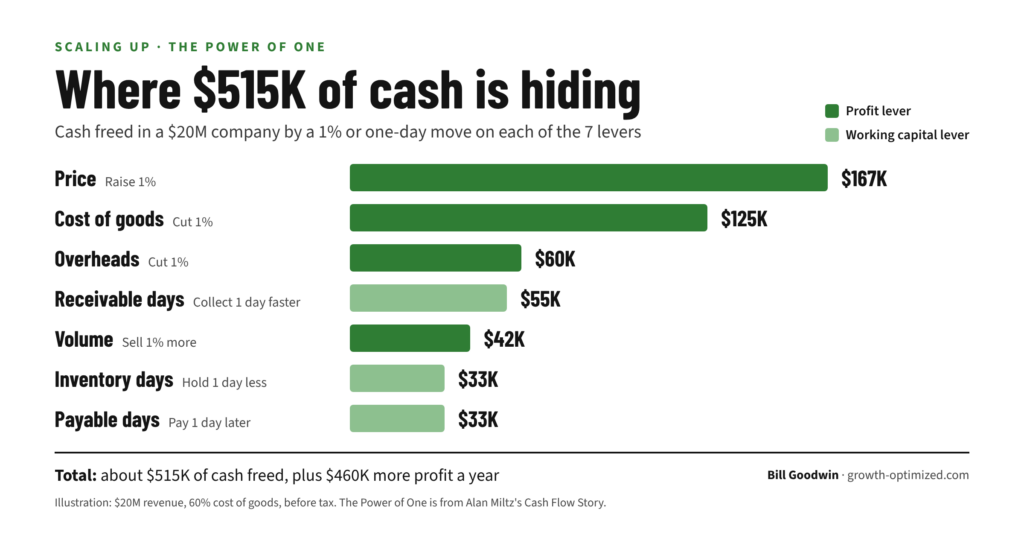
Price, volume, cost of goods and overhead drive profit. Receivable days, inventory days and payable days drive working capital. The Power of One is a financial modeling tool, created by Alan Miltz of Cash Flow Story as part of the Scaling Up methodology, shows what 1% or one day on each lever is worth. For a $20M company with 60% cost of goods, $6M of overhead and $2M of operating profit, collecting in 60 days, holding 45 days of inventory and paying suppliers in 30:
| Lever | The move | Added profit per year | Cash freed |
|---|---|---|---|
| Price | Raise prices 1% | $200,000 | $167,000 |
| Volume | Sell 1% more | $80,000 | $42,000 |
| Cost of goods | Cut cost of goods 1% | $120,000 | $125,000 |
| Overhead | Cut overhead 1% | $60,000 | $60,000 |
| Receivable days | Collect 1 day faster | $0 | $55,000 |
| Inventory days | Hold 1 day less inventory | $0 | $33,000 |
| Payable days | Pay suppliers 1 day later | $0 | $33,000 |
| Total | $460,000 | $515,000 |
Illustrative figures, before tax.
What about price and discounting?
When I was the CEO of a healthcare data analytics company, we increased pricing while factoring a small decrease in volume due to some customers not wanting to pay the higher price. The net effect was positive, driving higher profitability and cash flow.
Discounting typically gets you in trouble in terms of your overall valuation. That’s why I think it’s important to try and stay away from discounts.
How does cash affect what your company sells for?
Buyers want to see how effective you are at managing cash. One, do you have enough in reserve to weather some bad times, which we know happen? Two, are you consistently, month over month, showing that you have cash versus running out and having to borrow against lines of credit, whatever it might be? And third, are you actually deploying some of that cash into growth or into areas to make the business better? Buyers will look at all three of those.
At MeMD, we sold to Walmart at 9X revenue. Our cash discipline allowed our working capital target to be lower.
How do you make cash a leadership team habit?
When I work with companies, one of the areas we focus on is cash. Over time, through small improvements in the cash conversion cycle and in adjusting the seven levers that drive cash flow, we are able to generate more free cash flow to support higher growth.
In their first cash review, I have them go through the cash conversion cycle and pick one thing to work on that quarter, and we measure it in terms of number of days, how much we can shrink it. A lot of times that is collections and bringing money in, an easy place to start. We also then measure what that impact is in days and in dollars.
Frequently asked questions
Why do profitable companies run out of cash?
They underestimate the cost of growth, and they don’t keep working on ways to free up cash through internal operations.
What is the cash conversion cycle?
The number of days from when you spend a dollar until you get it back, hopefully with some profit.
What are the seven levers of cash flow?
Price, volume, cost of goods, overhead, receivable days, inventory days and payable days. The first four drive profit, the latter three drive working capital.
If cash is tighter than your profit says it should be, I offer a free Scaling Up assessment for your leadership team.
About the author
Bill Goodwin is the founder of Growth Optimized in Phoenix and a Certified Scaling Up Coach. He was CEO of MeMD, which he scaled and sold to Walmart at 9X revenue. Read more about Bill.
